



1.0 DEFINITIONS SPECIFIC TO THIS DOCUMENT
1.1 Capitalized words and phrases used in this Procedure document and not otherwise defined here have the meanings assigned to them in the Academic Appraisal Policy (PL-AC-09).
1.2 The following words and expressions are specific to this document and shall have the meanings hereby assigned to them:
1.2.1 Academic Appraisal Annual Report (AAAR): A document comprising the Appraisal Portfolio in addition to the supporting documents pertaining to the Academic Appraisal, such as: Action Plan template, Course Folder checklist, Course master syllabus template, and Course self-reflection report template.
1.2.2 Academic Calendar: A representation of the periods associated with the University’s operations, containing the teaching periods, exam and holiday dates, and key deadlines, which is approved by the University's Board of Trustees.
1.2.3 Academic Year: The 12-month period defined in the University’s Academic Calendar, as approved by the Board.
1.2.4 Action Plan: A document that describes the Academic Member’s planned activities and targets for the coming Appraisal Cycle in terms of time, effort, and deliverables in four key areas: Teaching, Scholarly & Creative Activities, Services and Academic Professional Development.
1.2.5 Course: A set of learning sessions in a particular subject, with a defined scope and duration, and specific Learning Outcomes.
1.2.6 Course Folder: An electronic folder that includes all relevant documents for one Course taught during the Appraisal Cycle.
1.2.7 Lead Principal Investigator (LPI): The person responsible for the technical, fiscal and administrative management of the Research Project in accordance with all relevant policies and procedures.
1.2.8 Research Project: Any project that forms the basis of Research undertaken by the University and includes projects undertaken by:
- a member of the University Community and/or Visitor or under their supervision,
- any individual commissioned by the University to undertake Research.
1.2.9 Teaching Load: The Teaching assignment of each Academic Member within the Academic Unit.
1.3 Where a word or phrase is given a particular meaning, other parts of speech and grammatical forms of that word or phrase have corresponding meanings.
1.4 Where the context requires, words importing the singular shall include the plural and vice-versa.
2.0 Procedure Purpose
2.1 This procedure provides a timeline and steps for the completion of the Appraisal Cycle as well as the criteria for evaluating Academic Members.
2.2 The following procedures are to be read in conjunction with Academic Appraisal Policy (PL-AC-09).
3.0 Procedure Statements
3.1 The Appraisal Cycle and the Evaluation Period is determined by the Vice-President, Academics at the beginning of each Academic Year, taking into consideration the Academic Calendar and the President’s approval.
3.2 Once the Appraisal Cycle is open, Faculty Affairs Department will provide an information session for Academic Members. The session will introduce Academic Members to the process, submission dates, and requirements for Academic Appraisal including all components of the Academic Appraisal Annual Report and any supporting documents.
3.3 Submission of Academic Appraisal Annual Report and Action Plan
3.3.1 All Academic Members, as defined in the scope of the relevant policy, must submit the Academic Appraisal Annual Report (see Annex A) to their respective Department/Program Heads. The Academic Appraisal Annual Report will include:
3.3.1.1 All academic activities and required documents for the Academic Appraisal, including evidence relating to Teaching and Academic Professional Development, Scholarly and Creative Activities, and Service to the University, profession, and community for the current Appraisal Cycle.
3.3.1.2 The proposed Action Plan for the coming cycle. Action Plans of previous Academic Year can be submitted as well.
3.3.2 The required documents will vary depending on the date of the Academic
Member’s appointment at the University and their employment status
(full-time, part-time, temporary, etc.). Table 1 shows what Academic
Members are required to submit based on the time they joined the University.
Table 1: Submission of academic activities documents
| Returning Academic Members | Submit the Academic Appraisal Annual Report including all required documents and evidence of academic activities performed in Fall and Winter Semesters of that Academic Year, Spring Semester of the Previous Academic Year, and the proposed Action Plan for the coming Appraisal Cycle. |
| Academic Members who joined the University in the Fall Semester of the Academic Year during which the current Academic Appraisal is performed | Submit the Academic Appraisal Annual Report including all required documents and evidence of academic activities performed in Fall and Winter Semesters of that Academic Year, and the proposed Action Plan for the coming Appraisal Cycle. |
| Academic Members who joined the University in the Winter Semester of the Academic Year during which the current Academic Appraisal is performed | Not required to submit Academic Appraisal Annual Report. These Academic Members will be under probation during the Appraisal Cycle and their performance during that period will be captured in the probation report. |
3.3.3 Part-time and temporary Academic Members must submit their Academic Appraisal Annual Report, including all required documents and evidence of Teaching-related academic activities performed in the Academic Year relevant to the Academic Appraisal Cycle. This excludes Scholarly and Creative Activities, Service and an Action Plan.
3.3.4 Department/Program Heads and Assistant/Associate Deans will be evaluated by their respective Dean/Academic Manager and will submit the following:
3.3.4.1 Academic Appraisal Annual Report, including:
3.3.4.1.1 All required documents and evidence of academic activities relating to administrative duties/Service (see Annex B), Teaching and Academic Professional Development, and Scholarly/Creative Activities.
3.3.4.2 The proposed Action Plan for the coming Appraisal Cycle.
3.3.5 The Department/Program Head and/or the Dean/Academic Manager may request from Academic Members any missing information or documentation. Academic Members must submit this requested information within one (1) week or make special arrangements with the Department/Program Head.
3.4 Evaluation Period
3.4.1 During the Evaluation Period, the Appraisal Cycle (detailed under Table 1) will be carried out in three phases:
3.4.1.1 Preliminary evaluation;
3.4.1.2 Final evaluation; and
3.4.1.3 Academic Appraisal Meeting.
3.4.2 Preliminary Evaluation
3.4.2.1 The preliminary evaluation is carried out by the Department/Program Heads, who is responsible for the following:
3.4.2.1.1 Reviewing the Academic Appraisal Annual Report.
3.4.2.1.2 Providing their preliminary evaluation and recommendation in the Academic Appraisal evaluation report (see Annex C).
3.4.2.1.3 Reviewing the proposed Action Plan and providing their feedback on the Action Plan.
3.4.2.1.4 Meeting with the Academic Members to discuss their Academic Appraisal.
3.4.2.1.5 Submitting each Academic Member’s Academic Appraisal evaluation report and the proposed Action Plan to the Dean/Academic Manager for review and final evaluation.
3.4.3 Final Evaluation
3.4.3.1 The Final evaluation is carried out by the Dean/Academic Manager, who is responsible for the following:
3.4.3.1.1 Reviewing each Academic Member’s Academic Appraisal Annual Report and providing their evaluation in the Academic Appraisal evaluation report (Annexes C & D as applicable), taking into consideration the preliminary review prepared by the Department/Program Head.
3.4.3.1.2 Reviewing each Academic Member’s proposed Action Plan, taking into consideration Department/Program Head’s comments, and providing his/her feedback in the Action Plan.
3.4.3.1.3 Sharing the Academic Appraisal evaluation report with the Academic Member and inviting him/her for an Academic Appraisal meeting.
3.4.3.2 Within three (3) working days of receiving the Academic Appraisal report from their Dean/Academic Manager, Foundation Program Unit, the Academic Members will acknowledge receipt of the evaluation and accept the invitation for the Academic Appraisal meeting.
3.4.4 Academic Appraisal Meeting
3.4.4.1 The Academic Member and Dean/Academic Manager will meet, on a need basis, to discuss the evaluation. At the end of the meeting, the Academic Member will sign the Academic Appraisal evaluation report.
3.4.4.2 In case of disagreement, the Academic Member may submit an appeal to the Vice-President, Academics, as outlined in section 3.12.
3.4.4.3 The Academic Member must acknowledge any changes required by the Dean/Academic Manager, Foundation Program Unit to the proposed Action Plan. If changes are required, the Academic Member will make the changes, tick the Final box, sign, and submit the final Action Plan. Final Action Plans will form the basis for the subsequent evaluation for the coming Appraisal Cycle.
3.4.4.4 All final evaluation reports must be completed and signed by the Dean/Academic Manager, Foundation Program Unit, Department/Program Head, and the Academic Member.
3.4.4.5 The Dean/Academic Manager, Foundation Program Unit will submit all final evaluation reports to the Human Capital Directorate and submit a copy to the Faculty Affairs Department for documentation.
3.5 Final Reports
3.5.1 Once all Academic Annual Appraisal Reports and evaluation reports have been signed, the Administrative Assistant of each Academic Unit will collate the reports, ensuring the highest standards of document security, and submit the reports to the Faculty Affairs Department.
3.5.2 The Faculty Affairs Department will review the reports for completeness, provide a summary report to the Vice-President, Academics, and share a copy of the final reports with the Human Capital Directorate.
3.5.3 The Faculty Affairs Department will maintain records of all Academic Appraisal reports.
3.6 Academic Appraisal Cycle Completion Timeline
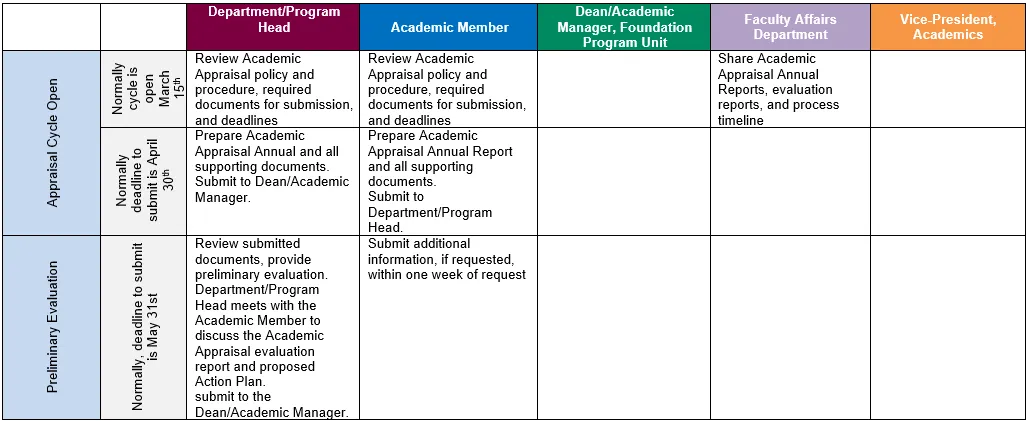
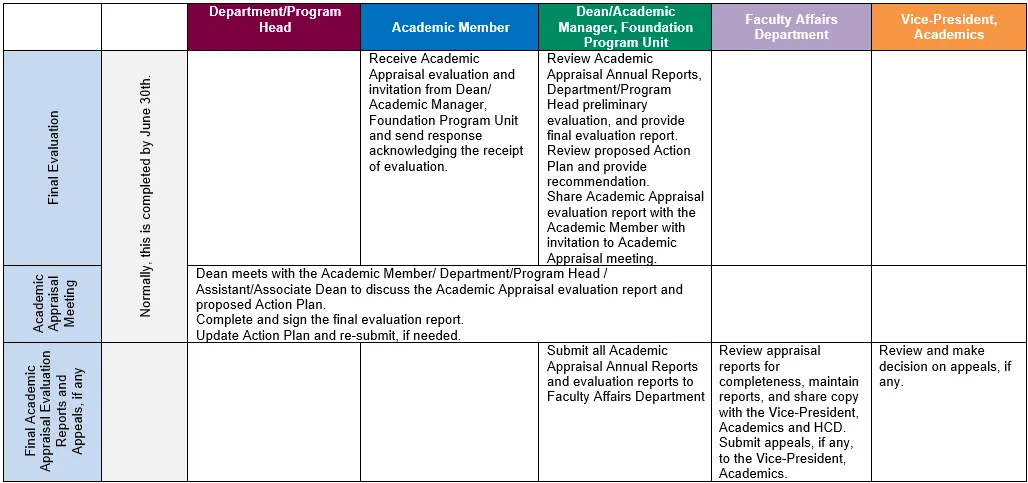
3.6.1 Table 2 illustrates the steps required by the Academic Member, Department/Program Head, Assistant/Associate Dean, Dean/Academic Manager, Faculty Affairs Department, and Vice-President, Academics through the Appraisal Cycle and a suggested timeline for completion.
Table 2: Academic Appraisal Cycle and Evaluation Timeline for full-time Academic Members and Program/Heads of Department
Notes: Part-time Academic Members will complete the Appraisal process during the Winter semester.
Deans, Academic Mangers, Associate Deans, and Assistant Deans will complete the Appraisal process during the Fall semester.
3.7 Academic Appraisal Evaluation Criteria
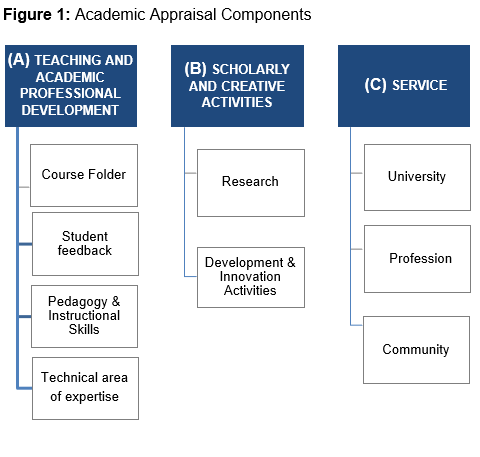
3.7.1 Figure 1 outlines the components of the Academic Appraisal: (A) Teaching and Academic Professional Development, (B) Scholarly and Creative Activities, and (C) Service to the University, profession and community.
|
3.7.2 Table 3 below outlines the weight ranges in each component of the Academic Appraisal. The weight indicates the required proportion of the Academic Member’s effort dedicated to each component throughout the entire Academic Appraisal Cycle, as in the Academic Member’s Action Plan.
3.7.3 The weight for each component will vary depending on the Academic Member employment status and responsibilities (full-time, part-time, temporary, Department/Program Head, or Assistant/Associate Dean).
Table 3: Academic Appraisal Components and The Weight Range
| Academic Member Group | Academic Appraisal Component | Academic Appraisal Weight |
|---|---|---|
| 1. Full-time Academic Members (PhD holders) | (A) Teaching and Academic Professional Development | 50-60% |
| (B) Scholarly and Creative Activities | 20-40% | |
| (C) Service | 10-20% | |
| 2. Full-time Academic Members (Below PhD) | (A) Teaching and Academic Professional Development | 60-80% |
| (B) Scholarly and Creative Activities | 0-20% | |
| (C) Service | 20% | |
| 3. PT/ Temp – Teaching | (A) Teaching and Academic Professional Development | 100% |
| (B) Scholarly and Creative Activities | 0 | |
| (C) Service | 0 | |
| 4. Department/ Program Head, and Assistant/Associate Dean | (A) Administrative Duties/Service | 50-85% |
| (B) Teaching and Academic Professional Development | 15-30% | |
| (C) Scholarly/Creative Activities | 0-20% |
Note: Foundation Program Unit Academic Members are not evaluated on Research.
3.7.4 Full-time, part-time and temporary Academic Members must allocate the following weights for the sub-components in component A (Teaching and Academic Professional Development):
3.7.4.1 (10%) of the total weight allocated for component A must be assigned to Student | Course Instructor Survey.
3.7.4.2 (5 – 10%) of the total weight allocated for component A must be assigned to Academic Professional Development.
3.7.5 Department/Program Head and Assistant/Associate Dean must allocate the following weights for the subcomponents in component A (Teaching and Academic Professional Development):
3.7.5.1 (10%) of the total weight allocated for component A must be assigned to the Student | Course Instructor Survey.
3.7.5.2 (5 – 10%) of the total weight allocated for component A must be assigned to Academic Professional Development.
3.7.6 Department/Program Head and Assistant/Associate Dean will mainly be evaluated for their administrative duties/Service (50 – 85% weight allocation to this component). This includes but is not limited to:
3.7.6.1 Faculty leadership and guidance; Department quality control; faculty appraisal; Program development, review, and accreditation; faculty workload; faculty orientation and mentoring; support students and monitor their progress; service to the university, profession and community; etc.
3.7.7 The Academic Member will be given a qualitative score for each of the three (3) components of the Academic Appraisal as well as an overall qualitative score. The qualitative score will be as in Table 4:
Table 4: Qualitative Descriptors
| Qualitative Score | Criteria |
|---|---|
| Excellent | Academic Member has demonstrated or achieved outstanding accomplishments in all components of evaluation. Academic Member makes significant contributions to the tasks assigned. |
| Very Good | Academic Member has demonstrated or achieved more than what is required in all components of evaluation. Academic Member’s performance is above the expected level. |
| Good | Academic Member has demonstrated or achieved what is required in all components of evaluation. Academic Member performs all tasks assigned as expected. |
| Satisfactory | Academic Member has demonstrated or achieved more than what is required in one or more components of evaluation. Academic Member’s performance may require improvement in under-performing areas. |
| Unsatisfactory | Academic Member failed to fulfill the minimum required responsibilities in most or all components of evaluation. Overall Academic Member’s performance is unsatisfactory. |
3.7.8 The criteria used to evaluate each Academic Appraisal components are shown in Table 5:
Table 5: Evaluation Criteria for Academic Appraisal Components
| Academic Appraisal Component | Qualitative Score | Criteria |
|---|---|---|
| Academic Professional Development | Excellent | Attend 5 workshop/ Seminar/ Conference/ training/ PD days, 2 of which are conducted/ organized by the Academic Member and provide evidence of attendance. Provide evidence of using technology and implement new knowledge after taking workshop/training. |
| Very Good | Attend 4 workshop/ Seminar/ Conference/ training/ PD days, 1 of which is conducted/ organized by the Academic Member and provide evidence of attendance. Provide evidence of using technology and implement new knowledge after taking workshop/training. | |
| Good | Attend 3 workshop/ Seminar/ Conference/ training/ PD days and provide evidence of attendance. Provide evidence of using technology and implement new knowledge after taking workshop/training. | |
| Satisfactory | Attend 2 workshop/ Seminar/ Conference/ training/ PD days and provide evidence of attendance. Provide evidence of using technology and implement new knowledge after taking workshop/training. | |
| Unsatisfactory | No evidence provided. | |
|
Scholarly and Creative Activities (other items may be applied as per 3.9 in this procedure) (refer to Annex E for list major and minor research grants) |
Excellent |
3 journal papers + 1 conference/book chapter or, 2 journal papers + 1 conference/book chapter and 1 major research grant (Lead Principal Investigator (LPI)). |
| Very Good |
2 journal papers + 1 conference/book chapter or, 1 journal paper + 1 conference/book chapter and 1 major research grant (LPI). |
|
| Good |
1 journal paper + 1 conference/book chapter or, 1 conference/book chapter and 1 major research grant (LPI). |
|
| Satisfactory |
1 journal paper or 1 conference/book chapter or, 1 conference/book chapter and UREP/HSREP/minor QRDI grants (LPI). |
|
| Unsatisfactory | No evidence provided. | |
| Service | Excellent | Provide evidence of contribution to all 3 areas of Service. Develop new initiatives to the University, actively contribute to the committees/task force decisions, actively contribute to Program/curriculum development. |
| Very Good | Provide evidence of contribution to 2 areas of Service. Contribute to the development of new initiatives to the University, contribute to the committees/task force decisions, contribute to Program/curriculum development. | |
| Good | Provide evidence of contribution to 2 or 1 area(s) of Service. Contribute to the development of new initiatives to the University, and/or contribute to Program/curriculum development, and/or contribute to the committees/task force decisions and attend committee’s meetings. | |
| Satisfactory | Provide evidence of contribution to 2 or 1 area(s) of Service. | |
| Unsatisfactory | No evidence provided. |
3.8 (A) Teaching and Academic Professional Development
3.8.1 The evaluation of the Teaching will be determined by the Academic Member’s Teaching Load over the three Semesters of the Appraisal Cycle, and Teaching during Summer semester, if any.
3.8.2 The Teaching and Academic Professional Development components will contain four (4) sections: Course Folder, Student Course Survey (Student Feedback), Pedagogy and Instructional Skills, and Technical/Discipline-development.
3.8.3 Course Folder
3.8.3.1 The Course Folder is an electronic folder that contains documentation for one (1) Course taught during the Appraisal Cycle. It is presented as a completed Course in the Learning Management System (D2L). The Course Folder includes the following:
3.8.3.1.1 Course master syllabus;
3.8.3.1.2 Course self-reflection report, including reflection on strengths, challenges, and potential for improvement;
3.8.3.1.3 Course assessment of learning objectives that illustrates the alignment of each learning objective to a formative and/or summative assessment;
3.8.3.1.4 Exemplars of student work (Activities and Assessments, including high, medium and low student achievement); and
3.8.3.1.5 Course materials/resources.
3.8.3.2 The content of the Course Folder will be used to determine the score for the Teaching component through the evaluation of the Academic Member’s:
3.8.3.2.1 Integration of active learning and experiential learning strategies, use of technology and effective student engagement in the Course;
3.8.3.2.2 Use of assessment methods that enhance student learning. This will normally consist of formative assessment and informal diagnostic assessment;
3.8.3.2.3 Reflective practice and continued improvement.
3.8.3.3 Classroom Observation
3.8.3.3.1 The primary goal of the Academic Appraisal is to encourage professional growth in both pedagogical and technical aspects of instruction. Classroom observations remain one option through which the use of active and experiential learning strategies, formative and applied assessments, and effective student engagement may be observed to assess and support development of these skills. The University offers training on these skills throughout the Academic Year via the Applied and Experiential Learning Department. The Academic Member may choose to include documentation of these as part of the Course Folder.
3.8.4 Student Course | Instructor Survey
3.8.4.1 This is the cumulative instructor feedback rating achieved by the Academic Member on all Courses taught during the Appraisal Cycle, based on the results of the Student’s evaluation for the Course and the Academic Member.
3.8.5 Academic Professional Development
3.8.5.1 The University values the Academic Professional Development of all Academic Members. In this regard, Academic Members shall be involved in different types of training programs according to his/her needs for continuous improvement that can serve the University. The University recognizes two categories of Academic Professional Development: pedagogical development and technical/discipline development. While these two categories should generally be developed to equal extent, it is recognized that in some cases, depending on Academic Members’ experience and training, there may be greater emphasis in one category in order to meet instructional goals. An example of this might be a newly-hired Academic Member with current technical expertise who may not have extensive pedagogical experience. Such a member might commit a greater proportion of Academic Professional Development to pedagogical training in his/her first year at the University. Academic Members’ participation in both categories of Academic Professional Development will be submitted in the proposed Action Plan. Participation of the Academic Member in each category will be discussed with Dean/Academic Manager, taking into consideration the Department/Program Head’s recommendation during the Academic Appraisal meeting for approval, and is at all times subject to the Academic Member’s schedule and availability of allocated funds.
3.8.5.2 Pedagogy and Instructional Skills
3.8.5.2.1 Activities of this type include workshops, seminars, internal and external training sessions on teaching and learning topics such as active and experiential learning, collaborative teaching and learning techniques, effective integration of learning technologies, and effective assessment. At the University, this category of Academic Professional Development is supported through the Applied and Experiential Learning Department.
3.8.5.3 Technical/Discipline-Specific Development
3.8.5.3.1 Academic Members undertake pre-approved technical or discipline specific Academic Professional Development to improve competency with the content and technical skills related to their instructional responsibility, to maintain relevant technical qualifications or certifications, or meet needs identified by the University. Activities in this category may include Courses, seminars, workshops, conference participation, and technical research. At the University, each Academic Unit undertakes the responsibility for engaging the Academic Members in effective activities for technical/discipline Academic Professional Development, subject to availability of allocated funds.
3.9 (B) Scholarly and Creative Activities
3.9.1 Scholarly and Creative Activities are an important component of the evaluation. This component recognizes Research and innovative activities and accomplishments of Academic Members. The Research and/or development in this component is experiential and applied in nature and is aligned with the technical/vocational focus of the University. It may result in:
3.9.1.1 Discovery of new knowledge;
3.9.1.2 Solutions to existing problems in industry;
3.9.1.3 Development of new materials or practices;
3.9.1.4 New uses for existing materials or practices.
3.9.2 The results broaden and expand the technical and instructional environment in which the Academic Members and the University are situated.
3.9.3 Scholarly Activities
3.9.3.1 These pertain to applied Research and intellectual attainment, including:
3.9.3.1.1 Published journal papers;
3.9.3.1.2 Peer reviewed conference papers;
3.9.3.1.3 Books and book chapters;
3.9.3.1.4 Conference posters, seminars, and workshops presentations.
3.10 (C) Service
3.10.1 Academic Members are expected to apply their knowledge, expertise, and professional skills to benefit the University, the Students, the discipline or profession, and the community at large in a manner consistent with the University mission. Preferably, Service activities should be linked to the domain of expertise of the Academic Member and fall in one of the following categories:
3.10.1.1 Service to the University;
3.10.1.2 Service to the profession and discipline; and
3.10.1.3 Service to the community.
3.10.2 As part of the Action Plan for the Appraisal Cycle, the Academic Member negotiates with the Dean/Academic Manager, Foundation Program Unit on the type and scope of the Service activities that the Academic Member should focus on during the Appraisal Cycle.
3.10.3 Service is evaluated through documented Service accomplishments and is based on the significance and impact of the activities as well as on the role played by the Academic Member in providing this Service. Other contributions will be assessed according to the equivalence of their effort and contribution.
3.10.4 It is the responsibility of the Academic Member to provide all the necessary evidence to support reported Service activities. The evaluation of these activities will be based on a holistic appreciation of the Academic Member’s overall effectiveness, ethics, collegiality, impact and proactivity.
3.10.5 Service to the University
3.10.5.1 Academic Members are expected to contribute to the University efficiency and effectiveness. The following are examples of Service to the University:
3.10.5.1.1 Effective and constructive involvement in various department/ Academic Unit/University committees;
3.10.5.1.2 Active participation in developing the field of specialization in the University (i.e., Program development, active participation in launching a new Program, etc.);
3.10.5.1.3 Active participation in Program assessment, evaluation, and continuous improvement efforts;
3.10.5.1.4 Collecting assessment data and other preparation for accreditation;
3.10.5.1.5 Development of new University initiatives and/or bringing such initiatives to fruition;
3.10.5.1.6 Leading the effort or contributing as a member of a task force to address issues facing the University or its community;
3.10.5.1.7 Representing the University in external activities;
3.10.5.1.8 Contributing to Student welfare through engagement in supporting extracurricular Student activities, participating in Student-faculty committees, or serving as advisor to Student organizations;
3.10.5.1.9 Engaging in teaching Continuing and Professional Education (CPE) courses.
3.10.6 Service to the Profession
3.10.6.1 Academic Members are expected to be involved in Service to the profession and discipline. The following are examples of such involvement (evidence of these can take the form of certificates, letters of achievement or gratitude, promotional material, contact information of a referee) with prior executive approval:
3.10.6.1.1 Holding affiliations with professional associations in one’s field of expertise;
3.10.6.1.2 Contributions of time and expertise to serve external professional organizations and societies;
3.10.6.1.3 Serving as an appointed or elected officer of an academic or professional association;
3.10.6.1.4 Serving in areas of professional competence as a Head, an organizer or a Program committee member for conferences, panel sessions, workshops, or meetings;
3.10.6.1.5 Participating in external professional visits as an external program reviewer, competition judge, or accreditation organization representative;
3.10.6.1.6 Serving as the editor or a member of editorial board of professional journals;
3.10.6.1.7 Refereeing manuscripts submitted to journals or grant proposals submitted to competitive funding organizations.
3.10.7 Service to the Community
3.10.7.1 Academic Members are expected to be effectively involved in voluntary and non-compensated activities that raise the profile of the University in the greater community. The following are examples of Service to the community:
3.10.7.1.1 Collaborative endeavors with high schools, government agencies, and/or the industry;
3.10.7.1.2 Consulting with private and public organizations, with prior executive approval;
3.10.7.1.3 Making Research outcomes understandable and useable by the public, or by policy makers;
3.10.7.1.4 Having media communication in popular and non-academic media including social media, newsletters, newspapers, radio, and television on issues of general interest to the public;
3.10.7.1.5 Offering presentations, workshops, short Courses for the industry, the government, or the public;
3.10.7.1.6 Evaluating Programs or policies for external agencies;
3.10.7.1.7 Recruiting or informational visits to high schools;
3.10.7.1.8 Serving as a member of a board.
3.11 Action Plan
3.11.1 The Action Plan outlines the Academic Member’s intended commitment for the upcoming Appraisal Cycle in terms of time, effort, and deliverables in the following key areas of Academic Appraisal: Teaching and Academic Professional Development, Scholarly and Creative Activities, and Service to the University, profession, and community. It is important both in guiding the Academic Member’s priorities and time commitments throughout the Academic Year and as an objective means to demonstrate professional achievement and growth at the end of the Appraisal Cycle.
3.11.2 The proposed Action Plan is submitted to the Department/Program Head with the Academic Appraisal Annual Report, to be reviewed and discussed during the Academic Appraisal meeting in light of the Academic Member’s skills and interests and the needs of the Academic Unit and the University.
3.11.3 The final Action Plan arises from review and discussion with the Dean/Academic Manager. It will guide the Academic Member’s performance for the coming Appraisal Cycle and it will form the basis for the subsequent evaluation.
3.11.4 Academic Members must reflect on how they fulfilled the activities and deliverables of their Action Plan from the last Academic Appraisal Cycle.
3.11.5 In the event that the Academic Member has made changes to his/her final Action Plan during the Academic Appraisal Cycle, Academic Member must provide justification on changes of the expected deliverables of the Academic Appraisal components to be submitted and discussed with his/her respective Dean/Academic Manager during the Academic Appraisal meeting.
4.0 Related Documents
4.1 PL-AC-09: Academic Appraisal Policy.
4.2 PL-AC-11: Academic Professional Development Policy.
4.3 PR-AC-11: Academic Professional Development Procedure.
PR-AC-09: Academic Appraisal Procedure ©
January 2026